West side of [Moon Pyramid]
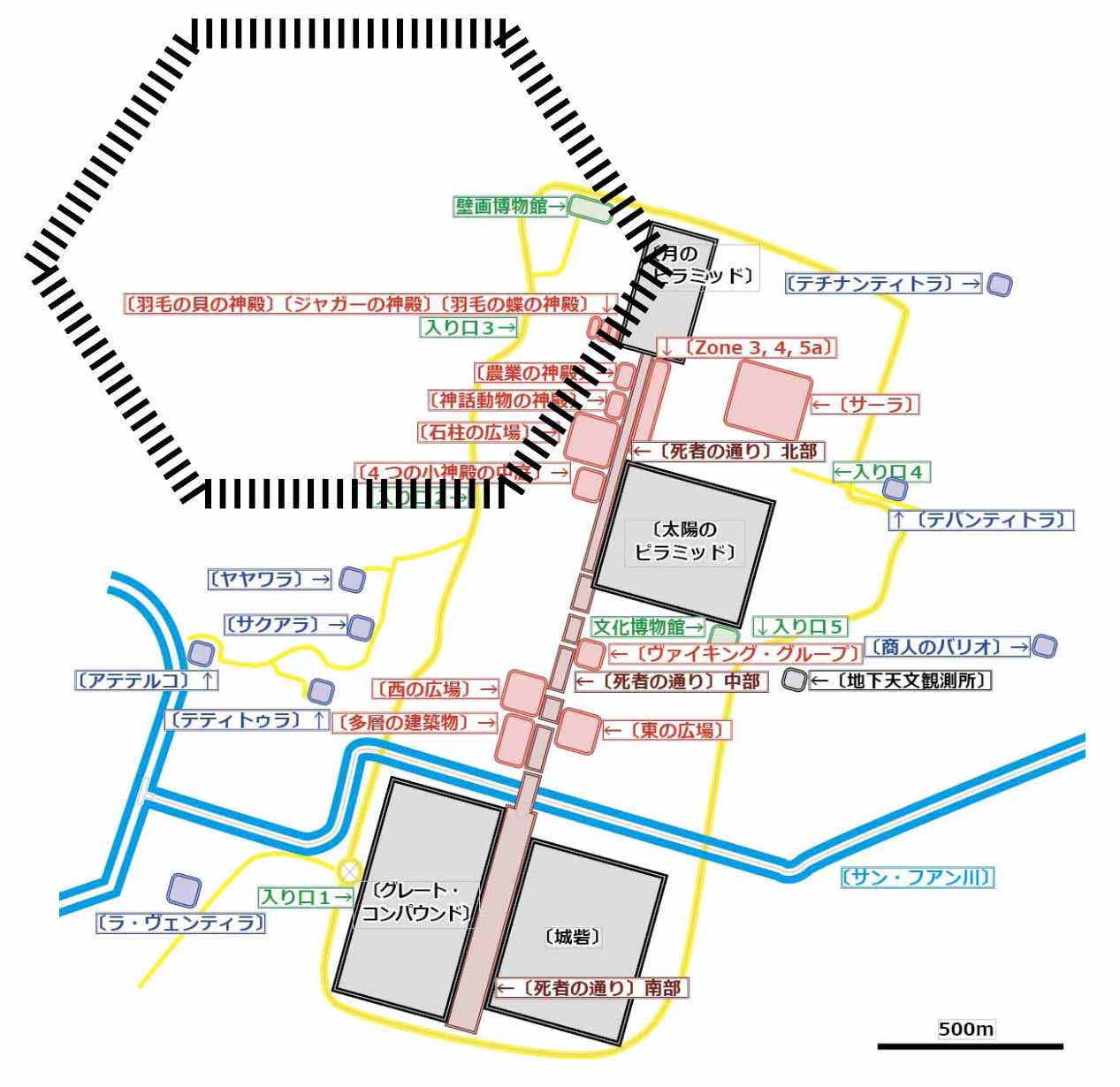
Traces of the period before the mega-buildings of 200 AD can be determined through analysis of pottery. In the map below, the area surrounded by the hexagon with the dashed black line is where the largest number of pottery fragments dating from 100 BC to 100 AD have been unearthed in this valley. It is assumed that this was the core of Teotihuacan. So, among the huge structures, the one closest to the oldest habitation area is the Pyramid of the Moon.
Moon Pyramid
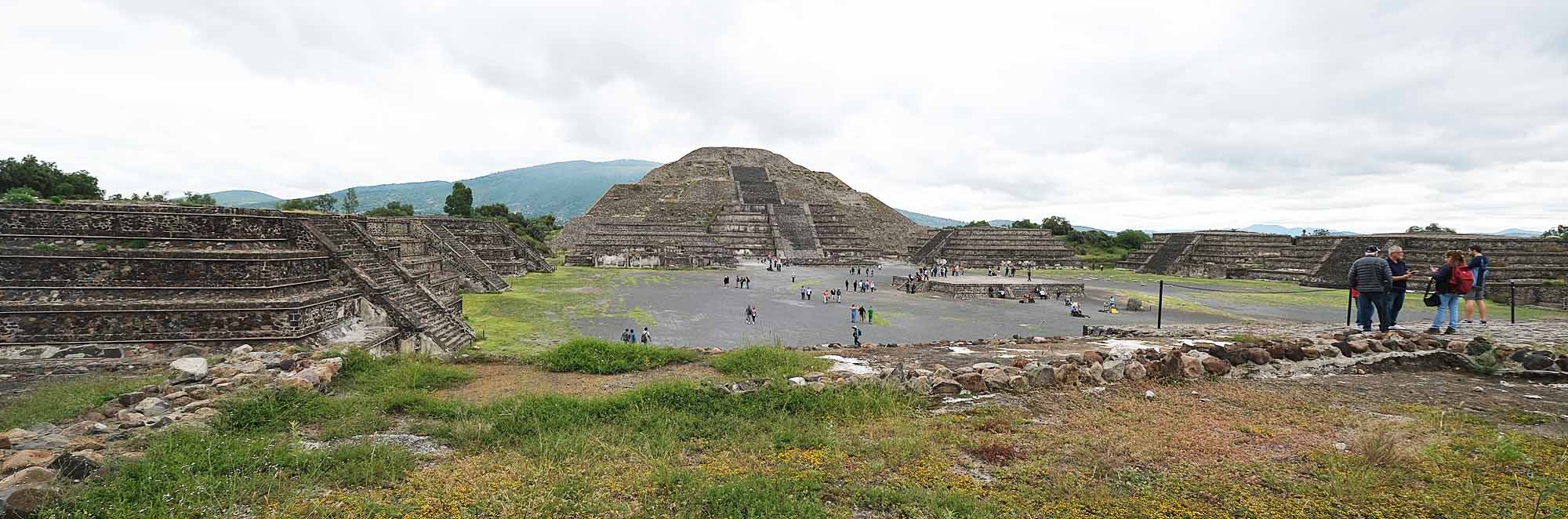
[Moon Pyramid] and south of it [Moon Plaza]. Although it is not visible in the photo, there is a [Street of the Dead] going south to the bottom right.
First, let's look at the [Moon Pyramid] from directly above.
↑on Google Map.
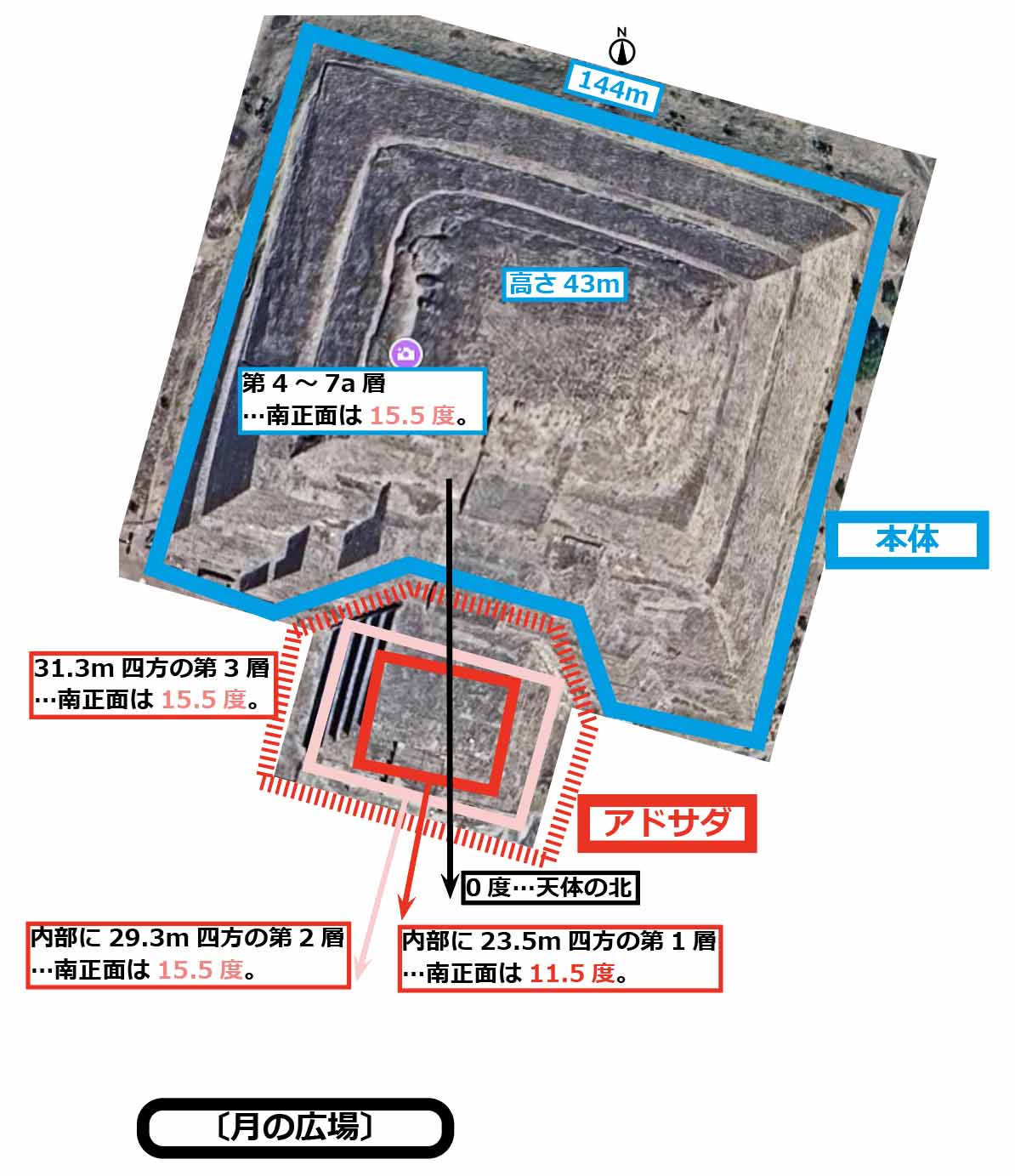
It can be divided into two parts. The blue line is the main body, and the red wavy line is Adosada. Adsada could also be described as a "main entrance platform." It is like the front entrance of the pyramid itself, and you can climb up there to reach the top of the pyramid itself.
The entire construction has gone through eight stages.
1st layer...100 AD...The base is 23.5m square.
2nd layer...120 AD...29.3m in east-west direction.
3rd layer...175 AD...Easy to west direction is 31.3m.
4th layer...250 AD...The bottom is 89m square.
5th layer...300 AD...North-south direction is 104m.
6th layer...350 AD...The base is 144m square.
7th floor...400 AD...Only Adsada was slightly enlarged.
7A layer…450 AD…Minor expansion.
From the 1st to the 3rd tier, a slight addition will be made to cover the previous tier. From the 4th layer, a new gigantic construction will suddenly begin north of Adsada. Finally, layers 1 to 3 and layers 4 to 7A were connected.
。The reason why the 4th floor was not built over the 3rd floor was probably because they did not want to make [Moon Plaza] too narrow.
It has been expanded to varying degrees approximately every 50 years, and has remained largely unchanged since its renewal in 350 AD. Approximately 50 years probably refers to the 52-year cycle in which the first day of the religious calendar and the first day of the solar calendar overlap again. It was a very important time milestone in the later Mexica culture. Therefore, building the 7th floor was an opportunity to make a major addition. It can be said that Teotihuacan did not, or could not, invest large amounts of building materials and large amounts of labor into the Pyramid of the Moon in 400 AD.
Sacrificial Tomb
There are reports from archaeologists who have dug modern tunnels into the pyramid itself. Five tomb chambers were found. Roughly speaking, each grave chamber is approximately 4 x 4 x 2 meters deep. Discoveries are arranged in chronological order of construction.
2nd tomb chamber... On the ground when the 4th floor was expanded, closer to Adsada.
6th tomb Chamber...The central location of the entire 4th layer.
3rd tomb chamber... north end of the ground of the 5th layer.
5th tomb chamber...The top platform of the 5th floor at the start of the 6th floor extension
4th tomb chamber... Ground level approximately in the center when the 6th floor was constructed.
Usually, in archaeological sites, similar artifacts and buildings are assigned consecutive numbers. If names and numbers are not set in the order in which they are discovered, conversations between those involved will not go smoothly. It often happens that the newly discovered Temple 3 turns out to be older than the one named Temple 1 at the beginning of the excavation. However, changing the number can confuse the conversation if the latest information is not immediately known.
Also, the floor plan does not show "1st Tomb Chamber". I have yet to come across a book that explains why, but I can imagine it. Archaeologists at the time probably began digging tunnels in the Pyramid of the Moon, thinking that there might be a royal tomb there. The appropriate name for a royal tomb is "1st Tomb Chamber.'' Therefore, since it is a tomb chamber that does not look like a royal tomb, I think they started numbering it from "2nd.'' We don't know whether the royal tomb never existed in the first place or whether it has simply not been found yet.
Common features among the five tomb chambers include multiple bound humans, gorgeous greenstone necklaces and figurines, obsidian knives, and a wide variety of animals. The grave goods are luxurious, but the fact that his hands were tied behind his back raises the possibility that he was a prisoner of war. In other words, it can be said that they were not local elites who died of natural causes.
The most interesting thing is the 5th tomb chamber.
1. Strontium isotope tests showed that all three were of Mayan origin.
2. Judging from their clothing, one person was a high-ranking person and two were martyrs.
3. Jade ornaments from the Motagua River in the Maya region were buried.
4. Buried around 350 AD
If this dignitary was a prisoner of war, there must have been a battle between Teotihuacan and the Mayan city-state, but no stone monuments have been excavated to commemorate it. Judging from the martyrs and their grave goods, it appears that this was a very "static sacrificial burial."
Hmm, sounds like there was some extra drama to this one.
Change of urban design axis
By the way, the height of the 23.5m x 23.5m building on the first floor is unknown, but when measured from the found foundation, the façade was in the north-south direction, and the southern end was tilted 11.5 degrees to the west. And that of the second layer was 15.5 degrees. This angle was that of the Street of the Dead and the axis of the city-wide architectural grid until its collapse in 550 AD.
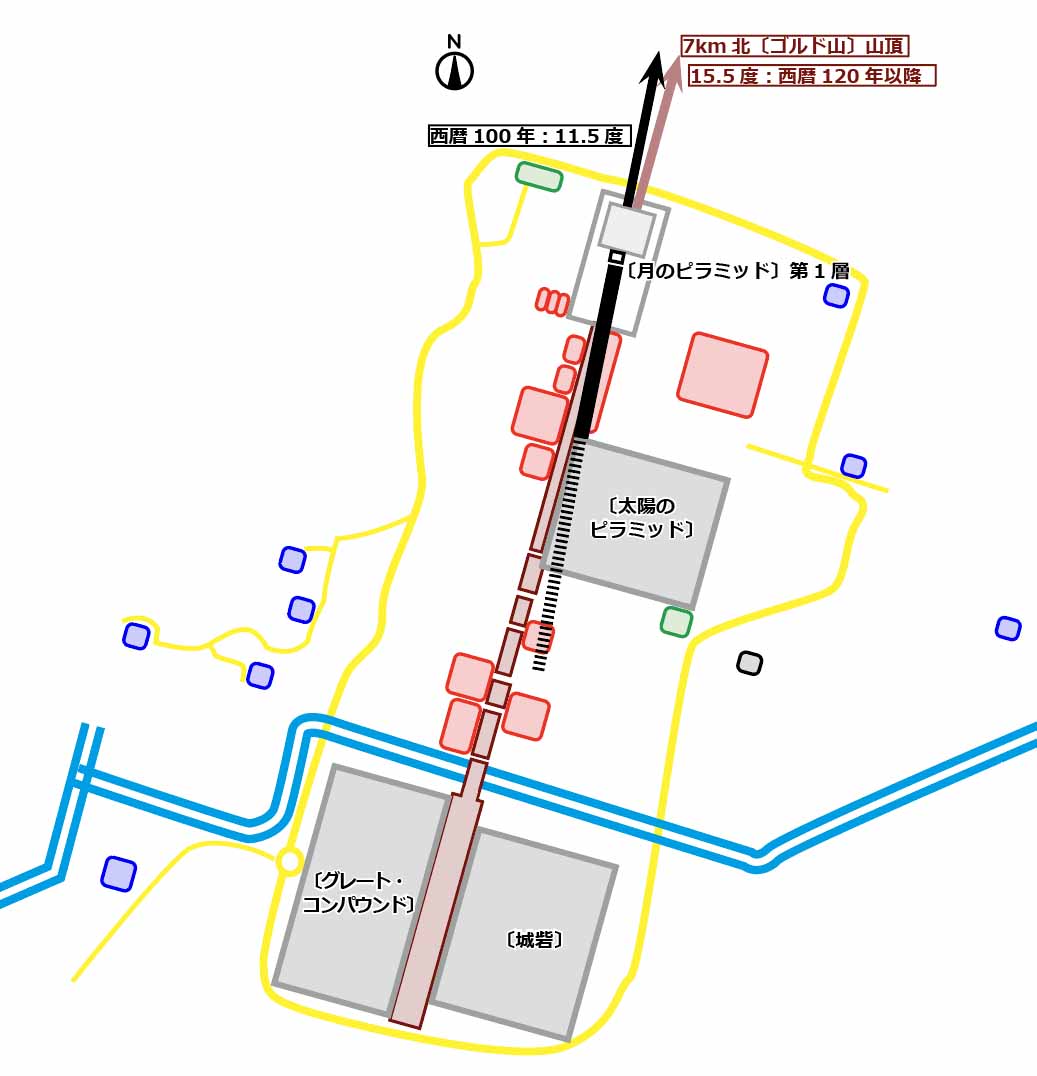
Archaeologists have searched for the reason for the "four degrees of change." The conclusion was that the leaders of Teotihuacan in 120 A.D. wanted people climbing north on the Street of the Dead to see Cerro Gordo beyond the Pyramid of the Moon.
In 120 AD, the Pyramid of the Sun did not yet exist. Also, the axes of the buildings inside the Pre-Ciudadela, which was the stage before the Ciudadela was built in 200 AD, were at multiple angles, such as 11.5 degrees and 48 degrees.
Now, let's return to the first floor. Why did the leaders of 100 AD build the first floor at an 11.5 degree angle in the first place? There is no way they would have known about the North Star, so there must have been a reason for shifting it from that. It could have been the magnetic north at the time, or they could have taken into consideration the position of Venus on a certain day, or perhaps a prophecy obtained during some kind of ritual indicated that direction - we don't know. My hypothesis is listed in the Xochitl Temple.
Moon Plaza
It is located south of the Pyramid of the Sun, measuring 160m north to south and 150m east to west. There are seven temples on each side. There are two altars inside, and the southern edge of the Plaza of the Moon is directly connected to the Street of the Dead. There is no wall at the boundary, so it is thought that access was not very restricted.
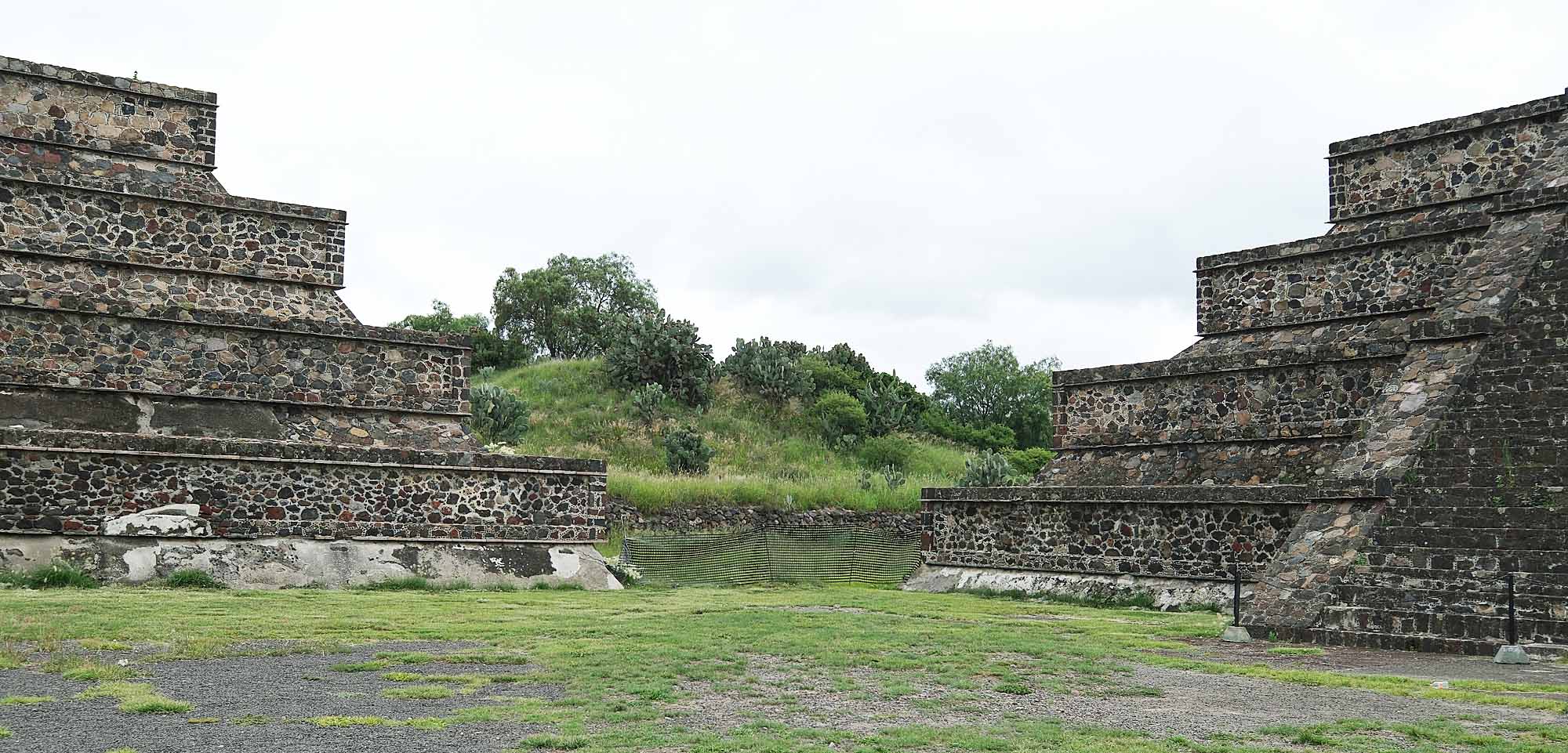
The excavation plan shows the foundations of many buildings just outside the Pyramid of the Moon and Plaza of the Moon. However, no report has been found that explains what they were used for. Even if you want to see them, they are covered with earth, as shown in the photo below, so you cannot see them.
Various rituals must have been performed at the Pyramid of the Moon, 14 temples, and two altars. The Plaza of the Moon was likely a shared stage or viewing area. And for these rituals, a god was required. What kind of god this was would be clear if there were inscriptions or murals on the buildings, but there are none. However, there are some clues.
Water-Goddess = Chalchiuhtlicue
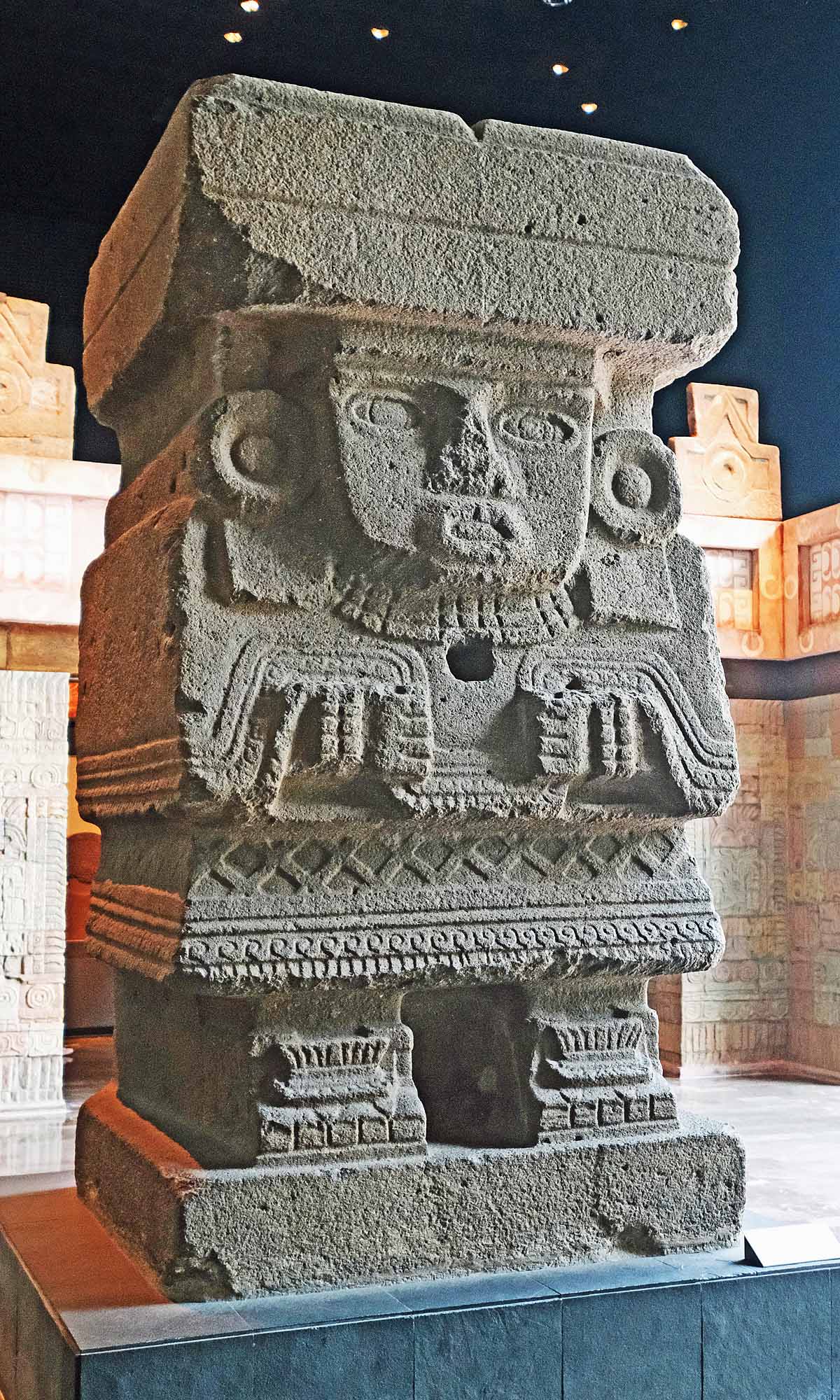
↑at Museum of Anthropology.
The andesite statue is 3.19 meters tall and weighs 16.3 tons. It is likely a woman, as she is wearing a skirt. The small rounded objects at the bottom edge of the skirt are thought to be jade beads. Depending on how you look at it, they resemble small waves, while the broad circular shapes are a subtle symbol of the god Tlaloc. The slit in the center of the headdress represents the valley between two mountains, which in Mesoamerica is said to be where the rainwater that collects there helps grow corn.
Another god associated with water is Tlaloc, who is strongly associated with storms and rain, while the Water Goddess represents the surface of the water.
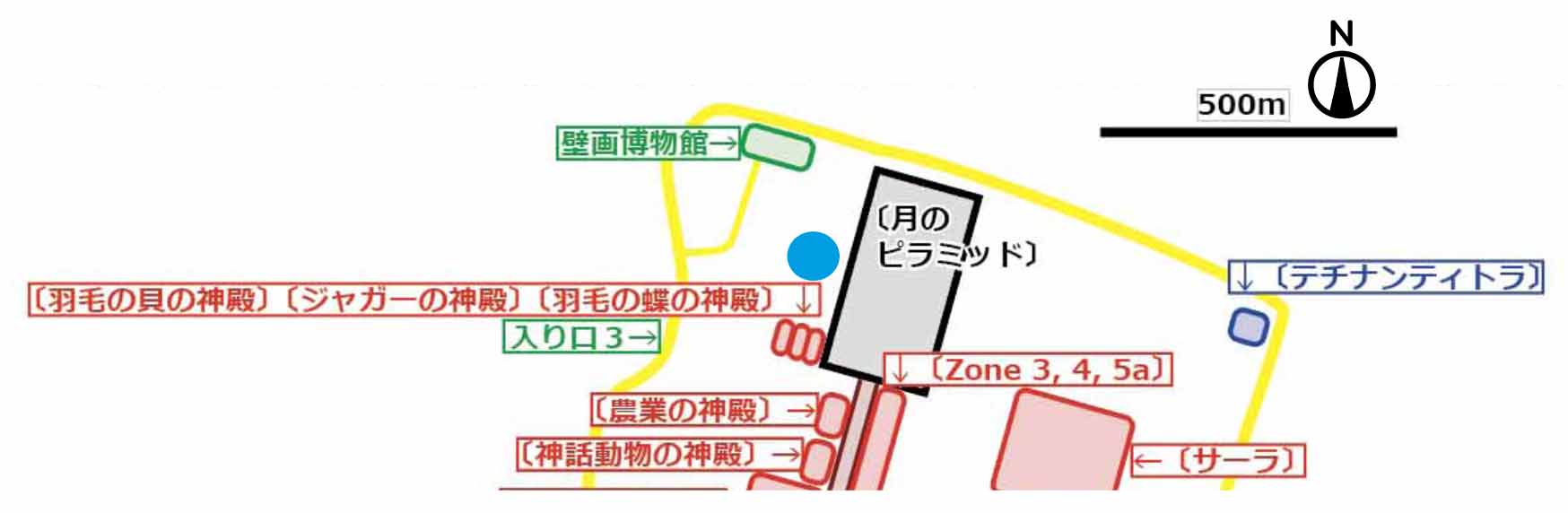
It was excavated in 1888, when a temporary railroad was built and it was transported to Mexico City. It seems to date from that period, but no clear drawings remain of where it was buried. Judging from the hazy and unclear hand-drawn diagram, it is likely to have been west of the row of small pyramids on the west side of the Plaza of Moon. It appears to have been in the area circled in light blue in the diagram below.
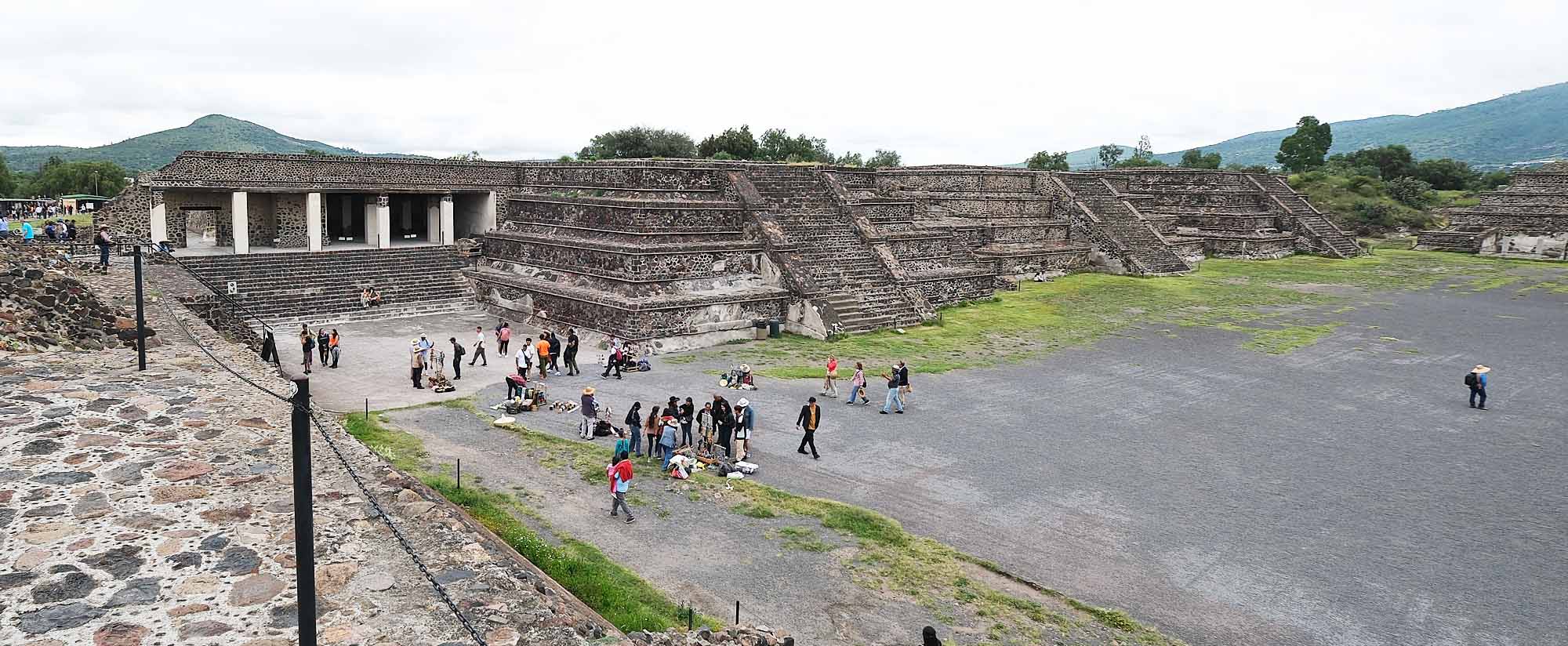
This is the west side of the Plaza of the Moon. The Temple of the Quetzalpapalotl can be seen on the left. Under the trees to the north of it is likely the site where the Goddess of Water was excavated. The area is currently off-limits, and is covered with earth, so nothing can be seen.
Since no other statues of gods have been excavated, it is believed that the main deity of the Pyramid of the Moon is the Goddess of Water.